Are you playing on your porch today? -Aug 26, 2017
General mountain dulcimer or music discussions
You'll be all set for porch-playing, Strumelia!
You'll be all set for porch-playing, Strumelia!
Today we are getting all the screens and the two screen doors installed on our brand new wonderful back porch!
I've been waiting over 15 years for this back kitchen porch to become a reality instead of just a wishful daydream. 


There are several examples of both in the video and audio pages.
Anyone have a sound clip playing a Dulcimore Dan or John Knopf traditional instrument?
gaelicgirl
Never too late, I hope you continue to enjoy strumming. Good luck with your new dulcimer, the adventure begins
If it were me, I'd cut BIG holes in the sides that will be joined together, and then glue them up; That way the sound can travel from end to end of the body very easily
If I glue several cigar boxes together, do I need to create an opening between them for the sound to move around or just put a hole in the top of them?
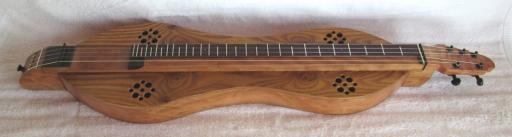
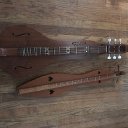
The VSL on this is 28 1/2 inches, 2 inch wide fretboard, 3 inch deep body, 12 1/2 wide lower bout, 44 inches overall length.
I have attached a couple pictures of it next to my Edd Presnell 3 string for perspective.
One of my larger ones, but I have several Carl Gotzmer/June Apple dulcimers that are also bigger, The "Cellomer" being 46 inches overall, VSL of 29 inches.
George, can you tell us the scale length of this dulcimer?
Yes, I like the "functional" art aspect too. I am now up to 32, all very playable, a lot with history behind them, all kept in tune, humidified, and played on a rotating basis.
I like different, but need to be playable.
Thanks!!
Well, WOW! I think it sounds great, and I loved listening to you play! I especially liked the last part, but I enjoyed all of it--
I did not think he meant the Blevins. I have 3 (vintage) dulcimers where the fret board goes out past the end and two of them produce cringe-inducing sounds, so I concur with him! Both made by makers with the history of making many instruments, so a person would think they would know better. In all three cases the dulcimers had something else unusual that attracted me--a carved head stock, for instance. Hence I gave myself that mental note about not getting distracted in the future unless I strictly want wall art (which I don't! I like functional art!)!
I agree with Ken about Dulcimers where the fret board extends past the body, I have only one and pretty much never play it.
I don't think he was referring to this Blevin as the Fret board does not extend past.
I have posted a short sound clip so you can hear it, the play is sloppy but not meant to impress. Just wanted whom ever to be able to hear what it sounds like. I may make a more serious attempt later.
By the way, I have it tuned right now to C-G-C
 Now I just have to remember that and not get distracted by other pretty details!
FWIW, in 40 years of dulcimers I've seldom seen a good dulcimer where the fretboard extended beyond the body, regardless of how many instruments the builder has made
Thank you so much for your prompt reply, George! Just what I wanted to hear!
And, Ken, I'm just twice shy now because I used that "Well, this is number 217, so the builder must have known by then what he was doing!" logic on a fairly recent purchase online, only to discover that the instrument was well put together but is completely unplayable. But as I write this I am realizing that the instrument I'm talking about does have a fret board that extends off the end, so perhaps warping has robbed it of any good intonation. . . .
Back to the Blevins --I could only find an obituary with a fleeting mention of being a dulcimer maker and one comment on Everything Dulcimer (aside from Dan's comment below). I'd love it if you could post a link if you've found more info. Thanks to you both!
It seems to tune up just fine, I have played it up and down the frets and all sound fine, don't seem to be out of placement to me. I am no expert however, But I know a couple others I have that I can tell as I work up the fret board that start sounding "off".
If you aren't familiar with this Blevin model, It is a very large dulcimer compared to most, which I have always liked.
Bottom line I have no complaints.
I'll see if I open up some time and try to make a sound clip so you can hear it.
linda2 -- a little research shows that Milford Blevins was quite a prolific regional instrument maker from Tennessee who passed away in early 2016. Given the number of instruments he built over the years, I would assume that his instruments were fretted correctly. Mr Blevins was certainly no "one-off" builder who had little Idea of what he was doing!
Cool words when the Eclipse of the Sun tomorrow across the USA. Do Galax leaves have a shape of ellipse? "a closed plane curve generated by a point moving in such a way that the sums of it distances from two fixed points is a constant: a plane section of a right circular cone that is a closed curve".... It's sooooooooo interesting how things are named and where. I love the history of it all. I'll have to read up more on the Galax Dulcimers and their history. aloha, irene
I have a Bob Fletcher dulcimer, which he claims is a copy of the Audrey Hash original , he worked with her and her father for a while. There was a feature article about Bob in the DPN some years ago. The instrument I have (circa 1984) was originally fretted in 'an old style !' but has subsequently been refretted to equal temperament, not by me I would add, and has 'bead' fine tuners. Of course I had to make a couple just to see if they worked....... they did !
JohnH
My first dulcimer was built for me by Lucky Diamond in Silver Springs, MD. on March 10, 1976. I was first exposed to the dulcimer by Kevin Roth in 1975 at a tiny music fest in the suburbs of Philadelphia, where he was performing. I was really taken by the sound and his skill, but I was nervous about talking to him about the dulcimer, since I knew nothing about the instrument. He was nice enough to chat and suggest Diamond Dulcimers. So I called Diamond and I think he sent me some info, but I ended up ordering their 6-string, which I think they referred to as a church dulcimer, since it's loud. It has wooden tuning pegs. I drove to Silver Spring in my old Fiat Spider and it was a house in a residential section. I was expecting a music shop. Anyway, I recall next to nothing about the actual transaction, but it felt like I was there for 5 minutes and was back on the road to Pa. I recall trying to strum it while driving, but it was too large, so I placed in the floor of the passenger seat and leaned it vertically and would occasionally strum the strings on the way home. I was soooo excited. I played it for about 2 years, while working a 40-hour week and attending college. It was my stress relief, with my only instructional materials being what came with the dulcimer and my copy of "In Search of...". My younger brother was trying to be funny and do his Jimmy Page imitation with the dulcimer and snapped the headstock. I was heartbroken. Anyway, I carried the pieces of my dulcimer around for over 35 years until I joined FOTMD and decided see if anyone could help me repair it. First, I did try a local music shop that did repairs, they told me my dulcimer was junk and could not be repaired, and would happily sell me a McSpadden. That made me angry, like someone making fun of your kid. It went downhill from there with me having no intention of leaving my dulcimer with him, even if he could repair it. After some discussion on the builders page, I met Ken Longfield who is relatively local and willing to take a look at my "kid", I mean dulcimer. Ken is fantastic, he repaired my dulcimer and the broken heart from 35+ years ago. I'm so grateful. Anyway, that's my first dulcimer story.
stewart -- the Galax dulcimer is a "special case" of dulcimers designed and built in Virginia. Most of the VA dulcimers were elliptical or slightly teardrop in shape, but did not have the very deep sides and double back of the Galax regional instrument.
The museum instrument dated about 1800 is elliptical, about 1" deep, and perhaps 5-6" wide.
Galax dulcimers are elliptical, tend to be about 3" deep, almost invariably have the signature double back, and are noticeably wider -- 7-8" or thereabouts
That's an interesting story. I met Audrey's father, Albert Hash, when I interviewed for a position at their church. I never met Audrey. Her father made some really nice fiddles. My guess is that "Scottish" is a model name. It would be interesting to know how she arrived at that name. The Hashes, being of German descent (I think), probably would not have identified the dulcimer as a "Scottish" instrument.
Ken
"The dulcimer sings a sweet song."
When we say "a dulcimer is tuned to G (or D or C)" what we are most commonly referring to is not the key of the song being played (as Dusty so well explains), but the fact that unlike a chromatic instrument like a guitar, we tune the whole (mostly) diatonic dulcimer to a particular keynote. The keynote of the dulcimer is, under most circumstances and with most tunings, the note that the bass string is tuned to.
The Ginger instruments are designed and built to be pitched up higher -- G rather than D or C. Think of it as a soprano rather than an alto or tenor voice. That's not to say you can't put appropriate strings on it and play in C or B. However, the tiny volume of the body means that the instrument won't resonate as good as possible when tuned down that low.
Interesting. Especially the folklore of the "Scottish" instrument which we know is not accurate -- the British Isles never had a dulcimer-relative instruments until the early 20th century. Virginia is certainly one of earliest dulcimer-producing areas -- there is a dulcimer in a museum there reliably dated to 1800.
Dana, sorry, I'm getting in to this discussion late. Dusty really covered everything in his posts. Here is the information on the Ginger from the McSpadden website: 4 String Ginger, Flat Peghead, Hourglass with Cherry top, back and sides. Comes with a padded Teal nylon case.
McSpadden Ginger Models are smaller dulcimers with a 23 3/16” fretboard that can provide a high (Key of G) clear voice similar to that of a mandolin. On request they can be set up in the Key of D to be used as a smaller standard dulcimer for players who have difficulty reaching positions on a standard size fretboard. The voice remains bright and clear whichever key is chosen. The standard setup is G-d-gg. Optional setups are G-d-dd, D-A-dd, and D-A-AA. Included are 6 ½ and 13 ½ frets, Teal nylon padded case, pick & noter and warranty. When set up in Key of D a beginner instruction book is provided and for Key of G setups an extra set of strings is substituted for the book. No case upgrade is available for the Ginger. Other options available include: Strap Buttons (Chrome, Black or Gold); Upgrade to Black or Gold Tuning Pegs; Squeakless Strings.
Ken
"The dulcimer sings a sweet song."
Dana, if you only change the tuning one note in either direction, you probably don't need any kind of bridge compensation.
I like those lower tunings for fingerpicking, but I also like higher tunings for flatpicking. I would encourage you to play with your Ginger tuned to G and explore it for the different tone you get rather than trying to turn it into a standard dulcimer. And if you play with someone on a baritone dulcimer, the two of you will sound great because you'll both be tuned to the same key but one octave apart. Yummy stuff!
Dana, my previous post didn't really explain what a key is, and maybe that's what your initial question is.
Most songs center around a single note, a key tone (often referred to as the "tonic"). You can think of that as the home base of the song. Oh the song will meander to other notes, but it will always come back to that home base. But you can also play that song with a different key tone or a different home base. The meandering will move to different notes, but they will maintain the same relationships to each other and to the key tone. Think of that home base as the key. If you play a song with your home base on one note and I play the same song with a home base on a different note, we will sound OK individually, but we will clash when we play together. Each key comes with a set of notes that are likely to be used in that song and a set of chords that are likely to be used to accompany those notes.
When you use DAd tab to play while you are tuned GDg, it works because the relationships between the notes are the same. However, you will not actually be playing in the key of D (with D as your home base or key tone); you will be playing in the key of G (with G as your home base or key tone). So you will clash with dulcimers playing that same tab tuned DAd.
I hope that helps. If you want more, we should probably move to the Music Theory Group and start looking at the Circle of Fifths and other fun stuff that scares people unnecessarily.
Thank you Dusty! That's some great info! Right now, I play mostly in CGC or C#G#C#. I love a lower tuning. Can I get a compensated bridge if I want to change it out?
Dana, if you tune your Ginger to GDg, you can play everything you currently do in DAd. You will sound great. You will be in a higher register and a different key. Everything will be wonderful and you'll have fun. You can also tune to AEa and be in an even higher register.
Unless you start to play with other dulcimers tuned DAd, that is, for then you will not be in the same key. There are ways to play in G out of a DAd tuning and in D out of a GDg tuning, but that requires some more understanding of keys and the fretboard.
If you tune a Ginger to DAd you probably will need different gauge strings. McSpadden surely has recommendations for string gauges for a DAd Ginger and you can also use the Strothers String Gauge calculator , inputting the VSL and the desired tuning. That calculator errs on the light side, so feel free to use strings slightly heavier than what it indicates.
When you buy a Ginger from McSpadden, they use a slightly different bridge for DAd or GDg tunings. Can you switch tunings without a compensated bridge? Yes, and you might find it plays perfectly well. If you have a sensitive ear, however, you might find the intonation slightly off. If you want to tune your Ginger to DAd, then try it and see how it sounds. If you notice an intonation problem, you will want to get a compensated bridge.
But you already have dulcimers tuned DAd. Why not keep this one tuned GDg or AEa so that you can play in those keys and the higher register? I think you'll find it a refreshing change.
I just took possession of a Redwood/walnut ginger. It's very nice and has a great tone. It is tuned to G with an extra set of strings, 26, 14, 10.
My question is...what exactly does the G tuning mean? I realize Mac has you get a compensated bridge if you want it tuned to D. But what does that actually mean?
Can I play DAD tab? How should I tune it? Do I need to change strings to play in DAD?
Dusty? Ken? Looking for yall to chime in and let me know what exactly I have here. Thank you as always!
Here's a tune played on a dulcimer with diatonic/chromatic fretboard
Listen to Pastorale Michel Corrette by nickosullivan #np on #SoundCloud
https://soundcloud.com/nickosullivan/pastorale-michel-corrette
Marg, What a lovely setting for playing! I'm looking for similar chairs, but it's hard to find just the right height, cushiness, depth, etc. The hunt is ON!
Thank you for responding. I did try to see if I could isolate the problem to one string, and I could not. I think I will try different strings, though, and at your suggestion, I will use lighter gauge ones.
I don't think the instrument's sustain is a problem with the strings. You might try a lighter gauge string just to see if it changes anything, but it may just be an instrument that has a longer sustain.
For home playing, Brian and I bought these chairs several years ago, and we find them incredibly comfortable for playing music. They are also great for throwing in the car for playing music elsewhere:
http://www.homedepot.com/p/HDX-Black-Folding-Chair-2FF0010P/204269967
We have four of them, and keep them folded up hidden behind an open door when not in use. (our house is older so it has doors for every doorway, which is how people regulated/saved the winter heat in the old days... our modest sized living room alone has three doors! lol)
Thank you. Strumelia.
Trevor




 Blevin.m4a - 3.8MB